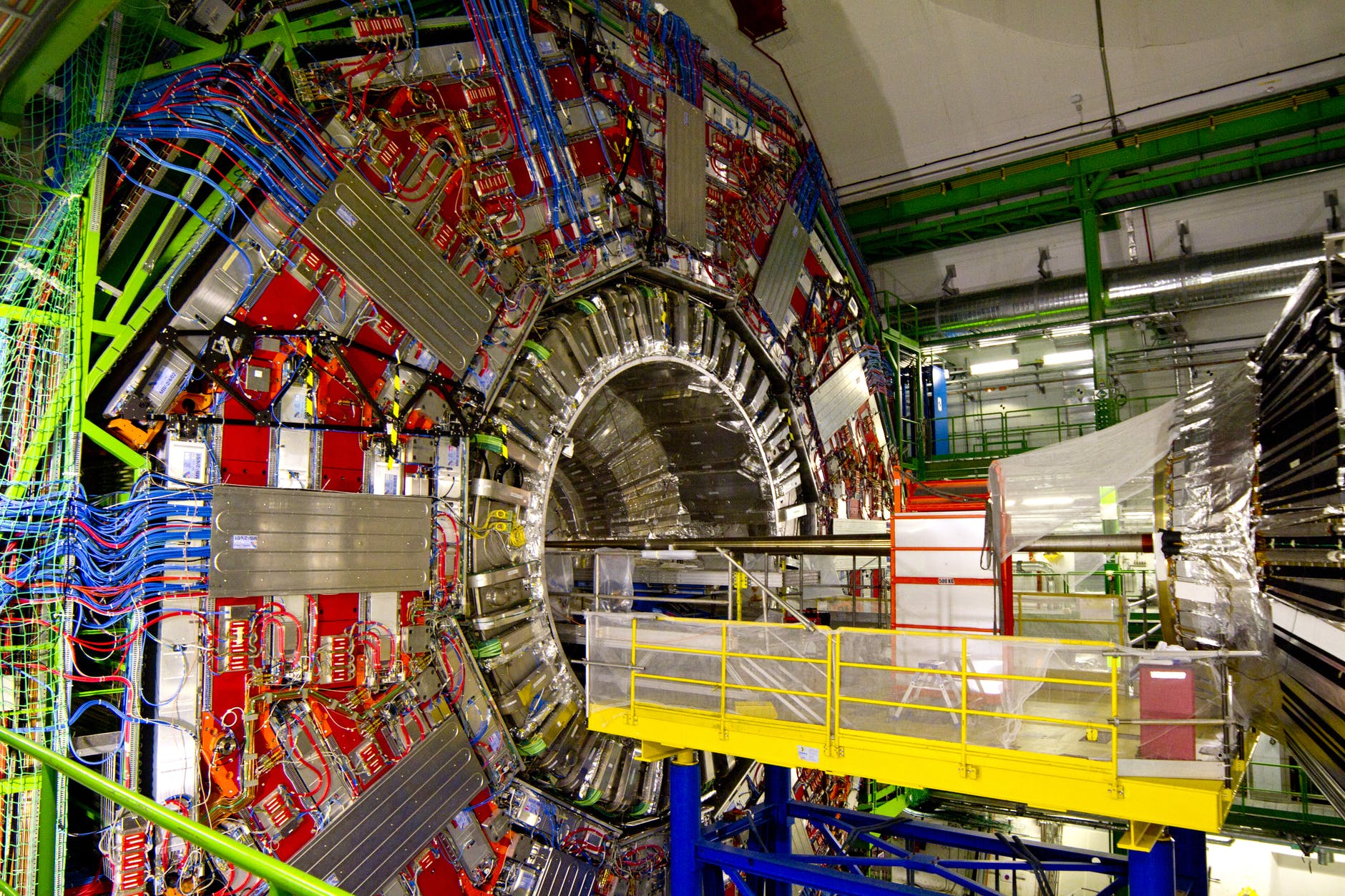
With protons being smashed together at unprecedented energy levels, the Large Hadron Collider prepares to reveal more secrets about the universe ten years after discovering the Higgs boson.
A three-year break for upgrades resulted in the biggest and most powerful particle collider in the world restarting in April.
During last week’s press briefing, the European Organization for Nuclear Research (CERN) said the project would be running continuously from Tuesday for nearly four years.
A 27-kilometer (17-mile) ring buried 100 meters under the Swiss French border, will be used to send two beams of protons and electrons around it at nearly the speed of light in opposite directions at nearly the speed of light. When the beams are sent, they will travel almost as fast as light.
As a result of these collisions, thousands of scientists will be able to record and analyze the data. This will be done as part of various experiments, such as ATLAS, CMS, ALICE and LHCb. These experiments will use the increased power of the accelerator to investigate dark matter, dark energy, and other fundamental questions.
Compared to a human hair, which is approximately 70 microns thick, the proton beams will be narrower this time around.
In July 2012, the Large Hadron Collider observed the Higgs boson for the first time. The enhanced energy rate will enable them to continue investigating the particle.
This time around, the collider will collide 20 times more than it did during its first run, which led to the discovery of the boson.
Physics was revolutionized by the discovery of the boson because of its connection to the Standard Model, which describes all fundamental particles and their interactions.
The newly upgraded collider will investigate the Higgs boson in depth after several recent findings have raised questions about the Standard Model.
Compared to the collider’s first run that discovered the boson, this time around there will be 20 times more collisions.
Several composite particles predicted by the Standard Model, including the tetraquark, such as the Higgs boson, have been measured in the past.
ALICE is one of the nine experiments planned as part of the Large Hadron Collider. The purpose of its experiment is to look for matter present in the first decade after the Big Bang. A “cosmic ray” simulation is based on collisions at the LHCf.
This run will be followed by the High-Luminosity LHC in 2029, which will produce ten times as many detectable events.
In addition to this, the scientists are also planning on building what is called the Future Circular Collider, an object comprising a 100-kilometer ring and aiming for energies as high as 100 trillion electronvolts.
However, they await the results of the third run of the Large Hadron Collider with bated breath.
Citations:
Wikimedia Foundation. (2022, July 3). Large hadron collider. Wikipedia. Retrieved July 4, 2022, from https://en.wikipedia.org/wiki/Large_Hadron_Collider
Guardian News and Media. (2022, July 4). CERN gears up for more discoveries 10 years after ‘god particle’ find. The Guardian. Retrieved July 4, 2022, from https://www.theguardian.com/science/2022/jul/04/cern-gears-up-for-more-discoveries-10-years-after-god-particle-find
Gibney, E. (2022, May 25). How the revamped large hadron collider will hunt for new physics. Nature News. Retrieved July 4, 2022, from https://www.nature.com/articles/d41586-022-01388-6
Encyclopedia Britannica, inc. (n.d.). Large hadron collider. Encyclopedia Britannica. Retrieved July 4, 2022, from https://www.britannica.com/technology/Large-Hadron-Collider
 Jonathon M. Poe